
For years, CLP compliance in the fragrance industry has largely meant the same thing: suppliers handing over raw documentation, scattered spreadsheets, and expecting customers to piece the puzzle together themselves. And to be fair, for a long time, that was the industry standard.
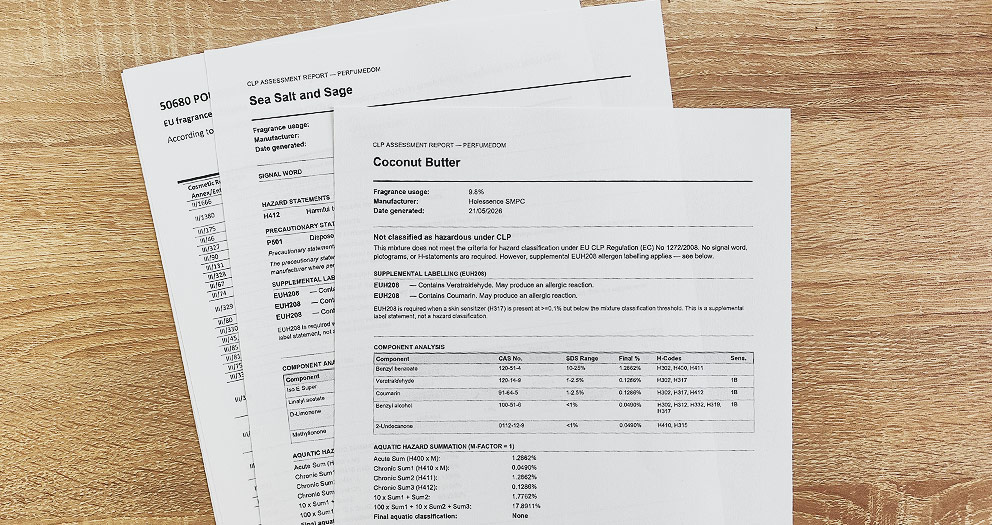
But as CLP requirements became increasingly complex, from EUH208 allergen labelling and H317 override thresholds to aquatic hazard calculations involving M factors, it became clear that static spreadsheets and basic label templates were no longer enough. At least not for us. And that is exactly why we built something different.
Introducing the izideal CLP Generator: a fully-featured compliance tool designed specifically for fragrance makers, candle brands, and home fragrance creators who want a more practical and intelligent way to approach CLP labelling.
Most CLP Mistakes Don’t Happen Because Your Label Looks Wrong
They happen because the underlying calculations were never done properly in the first place.
A misaligned pictogram is visible. A missing M factor isn’t. A wrong H317 sub-category won’t announce itself on the printed label. An absent EUH208 statement looks exactly the same as a label that correctly determined one wasn’t needed. The problem with incomplete CLP tools isn’t that they produce ugly labels, it’s that they produce labels that look fine.
That distinction is what drove us to build this. Not another label formatter. A tool built to take the regulatory side seriously.
The Industry Has a Design Problem
Let’s call it what it is. A significant number of CLP tools available to scent makers, artisan brands, and small manufacturers today are, at their core, glorified label designers. They give you a drag-and-drop interface, a color selector, maybe some pre-filled safety statements… and they call it compliance.
They aren’t.
They’re static templates dressed up as calculation engines. Pseudo-compliance gimmicks that handle the easy, visible parts of a label while leaving the hard, invisible parts (the ones that actually determine what should be on the label) to guesswork, omission, or outdated data.
Many tools on the market appear to prioritise aesthetics over the underlying regulatory logic. The label preview may look somewhat polished. The logic behind it does not hold up.
Design-only CLP tools are not compliance tools.
What a Real Calculation Engine Looks Like
The izideal CLP Generator is built to go far beyond basic label generators. Here’s what that means in practice.
M Factors in Aquatic Hazard Classification
When classifying a mixture for aquatic hazards, not all substances contribute equally. Some are so acutely toxic to the aquatic environment that they’re assigned a Multiplication Factor, an M factor, which amplifies their weighting in the additive calculation.
Most tools either ignore M factors entirely or apply a flat default. Our generator accounts for them properly, substance by substance. In a fragrance mixture with even a small concentration of a high-M-factor component, this can be the difference between a classification and none at all (or between Category 1 and Category 2).
H317 Overrides and the 1A / 1B Distinction
Skin sensitisation under CLP isn’t a single flat bucket. The regulation distinguishes between Category 1, 1A, and 1B – each representing a different level of sensitising potency, with different concentration thresholds for classification.
Our tool is built to handle all three sub-categories and the override logic that applies when individual component classifications interact with mixture-level thresholds. This nuance matters for what ends up on your label and, increasingly, for how regulators read it.
EUH208: The Statement Most CLP Tools Forget
EUH208 is one of the most frequently missing elements on scented product labels, and one of the most important to get right.
It’s required when a product contains skin-sensitising substances at concentrations below the threshold that would trigger a full H317 classification, but still high enough that EU regulations require disclosure. The statement names each applicable sensitising substance and reads: “Contains [name of substance(s)]. May produce an allergic reaction.”
Most tools don’t even check for it. Ours is built to identify when EUH208 applies, determine which substances need to be named, and generate the statement accordingly.
This is also where the distinction between full CLP classification and EUH208-only labelling becomes critical. A product can require EUH208 without carrying any hazard pictograms at all. These are fundamentally different regulatory outcomes that demand separate logic, not a single checkbox.
You can read more about how EUH208 works in our CLP Regulations guide.
Additive Logic and Application-Aware Guidance
Classification isn’t just about what’s in your fragrance oil. It depends on how much of it is in your final product, and what that product is.
The same fragrance at 8% in a candle and at 8% in a leave-on skin product can produce entirely different classification outcomes, because the application determines the relevant exposure pathway and concentration thresholds. Our tool is designed to take application context into account, helping you understand not just what the classification is, but why – and what changes if your usage rate does.
The Infrastructure Behind our CLP Tool
Live Regulatory Data from ECHA
Our generator references live regulatory data sourced from the European Chemicals Agency (ECHA) database, rather than working from a static internal table. CLP classifications are revised. Concentration limits are updated. A tool built on a snapshot from two years ago is working from a different regulation than the one in force today.
Referencing live data means the tool works with what matters now, not what was published whenever the last manual update happened.
21 Languages
A single input generates fully translated CLP label output in 21 EU languages. No separate workflows, no copy-pasting into a translation tool, no wondering whether the German statement matches the English one.
Assessment Reports for PCN Submissions
Labels are the visible output of a CLP assessment, but they’re not the whole picture.
For most products placed on the EU market, a Poison Centre Notification (PCN) submission is also required. Our tool generates detailed assessment reports designed to support that process: documenting the classification rationale, the substances involved, and the relevant thresholds in a format built for regulatory use… not just for printing.
This is the part that separates a compliance tool from a label printer.
You Wouldn’t Ask the Cashier for Medical Advice
You wouldn’t walk into a supermarket, stop the cashier at the checkout, and ask them for pharmaceutical advice about a drug on the counter. Not because the supermarket is bad at selling pharmaceuticals, but because regulatory and technical expertise belongs to an actual pharmacist. A different discipline entirely.
The same applies to fragrance oils and CLP compliance.
Many suppliers today operate as broad one-stop shops for candle making and crafting supplies. Which is fine as it is: product variety and convenience. Our field is fragrance chemistry, documentation, and regulatory infrastructure. Selling fragrance oils on top of a broad catalogue and understanding the regulatory logic behind them are two very different things.
CLP is a genuinely complex regulation. One that rewards careful implementation and penalises shortcuts that aren’t immediately obvious. M factors, override thresholds, EUH208 triggers, additive logic across substance sub-categories, application-specific concentration limits: these aren’t edge cases. They apply to a significant proportion of everyday scented products.
We built the izideal CLP Generator because our customers, formulators, home fragrance brands, and independent makers alike, deserve a tool that actually accounts for them.
For a full breakdown of CLP requirements, including EUH208, UFI codes, PCN obligations, and what each label element means, visit our CLP Regulations guide.



Write a comment
Your email address will not be published. All fields are required