

A heads-up for candle, soap and cosmetic makers!
Over the next months the fragrance world will quietly shift under the hood. New safety assessments from ECHA, updated IFRA Standards and the expanded EU cosmetic allergen rules mean that many fragrance houses are revising their formulas.
This is exactly the kind of work that happens in the background so that you can keep creating safely. We wanted to bring it to the front for a moment, explain what is changing and how we are handling it for you.
1. Which of our fragrances will be reformulated?
Our contract manufacturers are currently revising a small group of formulas in response to updated safety assessments and evolving regulatory limits from bodies such as ECHA and IFRA. These are targeted adjustments to keep the bases aligned with the latest toxicological and regulatory expectations, not radical redesigns of the scents! For our range, this affects the following fragrances:
- John Hardy Spear Flex Cuff, Sterling Silver, .Diamond 16 CT,4MM
- John Hardy Essential Pavé Bracelet, Sterling Silver, Diamonds, 2.5MM
- John Hardy Spear Flex Cuff, Sterling Silver, Black Sapphire, 5.5MM
- John Hardy Spear 50 Flex Cuff, Sterling Silver, 8.9MM
- John Hardy Icon 50 Bracelet, Sterling Silver, Leather, 17MM
- John Hardy Essential Pavé Bracelet, Sterling Silver, Gemstones, 2.5MM
- John Hardy Essentials Cross Bracelet, Sterling Silver
- John Hardy Icon Bracelet, Sterling Silver, Diamonds, 6MM
- John Hardy Icon Bracelet, Sterling Silver, Pave, 7.5MM
- John Hardy Icon Bracelet, Sterling Silver, Black Sapphire Clasp 10.5MM
- John Hardy Icon Bracelet, Sterling Silver, Diamonds, 6.5MM
- John Hardy Spear 50 Flex Cuff, Sterling Silver, Diamonds
- John Hardy Spear Flex Cuff, Sterling Silver, Diamonds, 5.5MM
- John Hardy Icon Bracelet, Sterling Silver, Gemstones, 5MM
- John Hardy Icon 50 Curb Bracelet, Sterling Silver, 11MM
- John Hardy Icon Bracelet, Sterling Silver, Gemstones, 6.5MM
This does not mean of course that the manufacturers will be “destroying” these formulas! They are making small tweaks so that their products can meet the new safety limits while staying as close as possible to the original character. For most users, the changes will be barely noticeable, but still, from a professional point of view, a revised formula is a new material and should be tested.
Best time to stock up
If you rely heavily on any of the fragrances above in an existing line, now is the ideal moment to stock up on the current version. Reformulations are expected to roll out in the next couple of months. Once a formula change is implemented, we will clearly mark it on the product page and update the documentation (SDS, IFRA, CLP where relevant).
2. Price changes on revised formulas
Regulatory-driven reformulations often come with small cost adjustments. Some raw materials become restricted, others need to be replaced with safer or more expensive alternatives.
What this means in practice:
- Some of the revised formulas will see minor price decreases
- A few will see price increases
Where prices go up, our policy remains the same as always:
We absorb as much of the raw material increase as we realistically can and pass on only what is necessary.
Any price adjustment will be communicated on the product page and, where relevant, through our newsletter so that you can plan your own pricing in advance.
3. New EU cosmetic allergen rules: what is changing?
Alongside IFRA and ECHA changes, the EU has updated the cosmetic regulation regarding fragrance allergens.
The short version:
- The list of fragrance allergens that must be declared on cosmetic labels is expanding from the classic “26 allergens” to a much larger list.
- New cosmetic products placed on the EU market must comply with this extended list by 31 July 2026.
- All existing cosmetic products must be updated or withdrawn by 31 July 2028.
This affects anyone using our oils in leave-on and rinse-off cosmetics (creams, lotions, perfumes, soaps, etc.), because your finished product labels need to reflect the allergens in your formula.
To support you with this, we are introducing a new document.
4. New “Extended Allergens Declaration” documents
In addition to the usual SDS and IFRA Certificate, we will be gradually adding a new file in the Downloads section of all of our products:
Extended Allergens Declaration
This document is designed for cosmetic manufacturers in mind, with more precise increments (%) of allergenic compounds and will:
- List the relevant fragrance allergens in line with the new EU allergen list
- Help you calculate and check whether your finished cosmetic needs to list specific allergens in the ingredients list
- Make it easier to keep your dossiers and product information files up to date for the 31 July 2026 / 2028 deadlines
We will roll these out slowly, starting from the fragrances most commonly used in cosmetic applications and when it is finalized, it will replace the classic 26 allergen declaration.
5. What about the next IFRA Amendment?
IFRA works in cycles. The 51st Amendment is already in force and fully applies to existing creations by 30 October 2025. The fragrance industry is now preparing for the 52nd Amendment, which is expected to be announced around 2026.
We do not have final details or dates yet. What we can promise is the following:
- Once the new IFRA Amendment is officially published
- Once our suppliers confirm how it affects specific bases
We will summarise the impact in plain language and share it through our newsletter and documentation, just as we are doing now.
No surprises, no last-minute panic.
6. The CMR reclassifications: the calm version (update 12/06/2026)
Some customers may have seen recent updates about fragrance ingredients being reviewed under the EU Chemical Strategy for Sustainability. This has understandably raised questions about whether certain fragrance materials will continue to be allowed in finished products.
At this stage, the situation is more specific than a simple list of banned ingredients. The practical impact depends on the individual substance, the final legal text, the product category, the concentration used in the finished product, and how the material is classified under CLP.
Our approach is to review these developments carefully, using supplier SDS data, IFRA documentation, and product-specific calculations where needed. This allows us to assess the real impact on our fragrance range without overstating the situation.
Separate from the IFRA and allergen updates above, the EU is also reviewing and reclassifying certain substances as CMR, meaning carcinogenic, mutagenic or toxic to reproduction, under CLP through the ATP process. The two ingredients closest to publication are heliotropin and tea tree oil, both proposed as reproductive toxicants, category 1B. A second group, including cyclamen aldehyde and several related fragrance materials, is expected to follow on a longer timeline.
Two separate points are worth keeping clear
First, the specific proposed changes discussed here are not legally applicable until the relevant ATP has been published in the Official Journal of the European Union and reaches its official application date. Until then, dates circulating online should be treated as provisional. We will not publish fixed deadlines unless they are supported by final legal text.
Second, candles, diffusers and room sprays are not cosmetics. In cosmetics, a CMR 1B classification can trigger a direct prohibition or restriction under the Cosmetics Regulation, subject only to specific legal exceptions. For candles, diffusers and room sprays, the mechanism is different. The relevant question is not simply whether the raw fragrance oil contains the substance, but whether the substance is present above the applicable concentration limit in the finished product.
Above the relevant concentration limit, the finished product may require the appropriate CLP classification and labelling. For consumer products, REACH restrictions on CMR 1A or 1B substances may also become relevant once the substance is legally listed and the change is in force. Below the applicable limit, those CMR-specific consequences would not normally be triggered by that substance alone, although other classifications may still apply depending on the full formula.
For candle use, fragrance oils are diluted into wax. This means the final level depends on the fragrance dosage used by the maker. At common candle fragrance loads, most affected oils are expected to remain below the level that would trigger a CMR classification in the finished candle. However, high fragrance loads and formulas sitting at the top of a declared SDS range should always be checked product by product once the final harmonised classification is published.
For leave-on or rinse-off cosmetics, the legal framework is stricter and should be checked directly against the Cosmetics Regulation and the finished formulation.
What this means for our range
We have checked our catalogue against the fragrance materials currently being discussed in the relevant CLH/ATP and SCCS context. Based on the supplier documentation currently held in our CLP database, the relevant materials identified in our main ready-to-order range are heliotropin/piperonal and cyclamen aldehyde.
a) We have not identified tea tree oil anywhere in our main ready-to-order range. We have also not identified acetophenone, para-cymene, cuminaldehyde or Cyclemax in the supplier documentation reviewed to date. b) We have identified diphenyl oxide/phenoxybenzene in one oil in our main range. This is being monitored separately because, based on the documentation currently reviewed, it is not part of the same confirmed harmonised CLP/ATP route as the materials discussed above. c) In our Scent Stash FW26/27 collection, we have also identified bourgeonal/p-tert-butyldihydrocinnamaldehyde in one oil, at trace level and on the later regulatory timeline.
At this stage, this does not mean that the oils identified above are banned, withdrawn, or automatically unsuitable for use. Where heliotropin, cyclamen aldehyde or bourgeonal appear, the practical question is not presence alone, but the concentration in the finished product. For candle use, the fragrance oil is diluted into wax, so the final level depends on the dosage used by the maker.
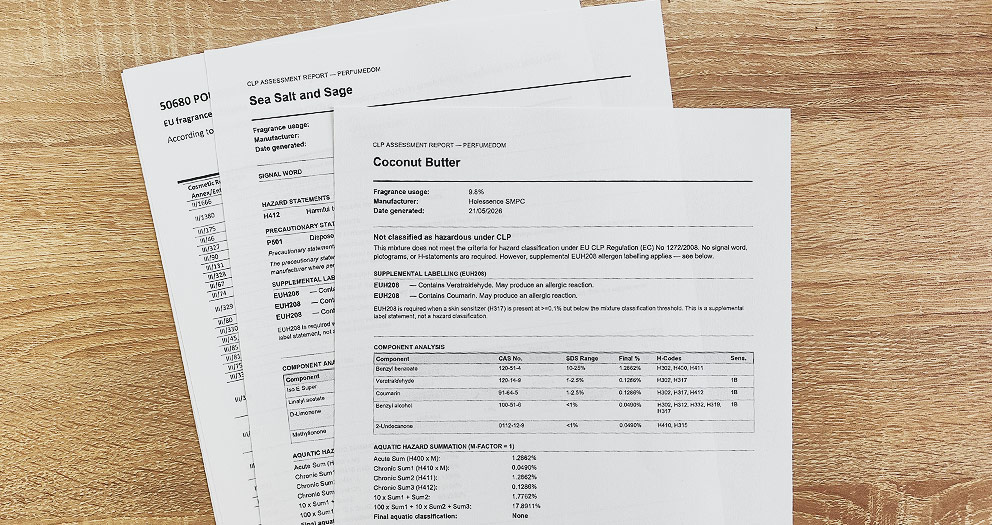
Rather than provide a static list that can become outdated when a formula or SDS is revised, we assess this per product. Each oil is supported by the SDS currently available to us, and our CLP tool reads the declared composition and concentration ranges to flag relevant substances for the specific oil and usage level selected.
We will continue monitoring the final legal text, supplier SDS updates and any confirmed ATP publication. If a change creates a practical impact for a specific oil or application, we will update the relevant documentation and guidance accordingly. This gives a more accurate answer to the question “is my product affected”: per product, using the available SDS data and the finished-product concentration, rather than relying on a generalised list.
What we have done instead of issuing a generic warning
A general regulatory notice can be useful, but it cannot answer the question most makers actually need answered: “Does this affect the oil I am using, at the percentage I use it?”
That is why we have updated our CLP tool with a dedicated Regulatory Watch layer. The tool now checks the selected fragrance oil against the relevant monitored substances, reads the available SDS concentration data, applies the selected usage level, and displays a product-specific notice where needed.
This is separate from the official CLP result. Proposed classifications are not treated as current law, and they do not alter the label output unless they become legally applicable. The Regulatory Watch section is there to give practical visibility, not to create unnecessary concern.
For us, this is the more responsible way to handle regulatory uncertainty: not with a plain PDF thrown at a newsletter and a static list that may quickly become outdated, but with a live, product-specific check based on the documentation available for each oil.
In plain English
❌ No, your candles are not suddenly illegal.
❌ No, there is no confirmed enforcement date until the relevant ATP is published in the Official Journal.
❌ No, presence in a fragrance oil does not automatically mean the finished candle is affected.
✔️ Yes, some fragrance oils in the industry contain materials currently being reviewed.
✔️ Yes, we are checking our range against the relevant CAS numbers.
✔️ Yes, if a product needs attention once the final classification is published, we will flag it clearly.
For most candle makers using normal fragrance loads, the practical impact is expected to be limited. For cosmetics, high fragrance loads, or products made close to classification thresholds, each formulation should be checked individually.
When the Official Journal publishes, you will get a confirmed update with real dates, here and through the newsletter.




Write a comment
Your email address will not be published. All fields are required