
Best Seller
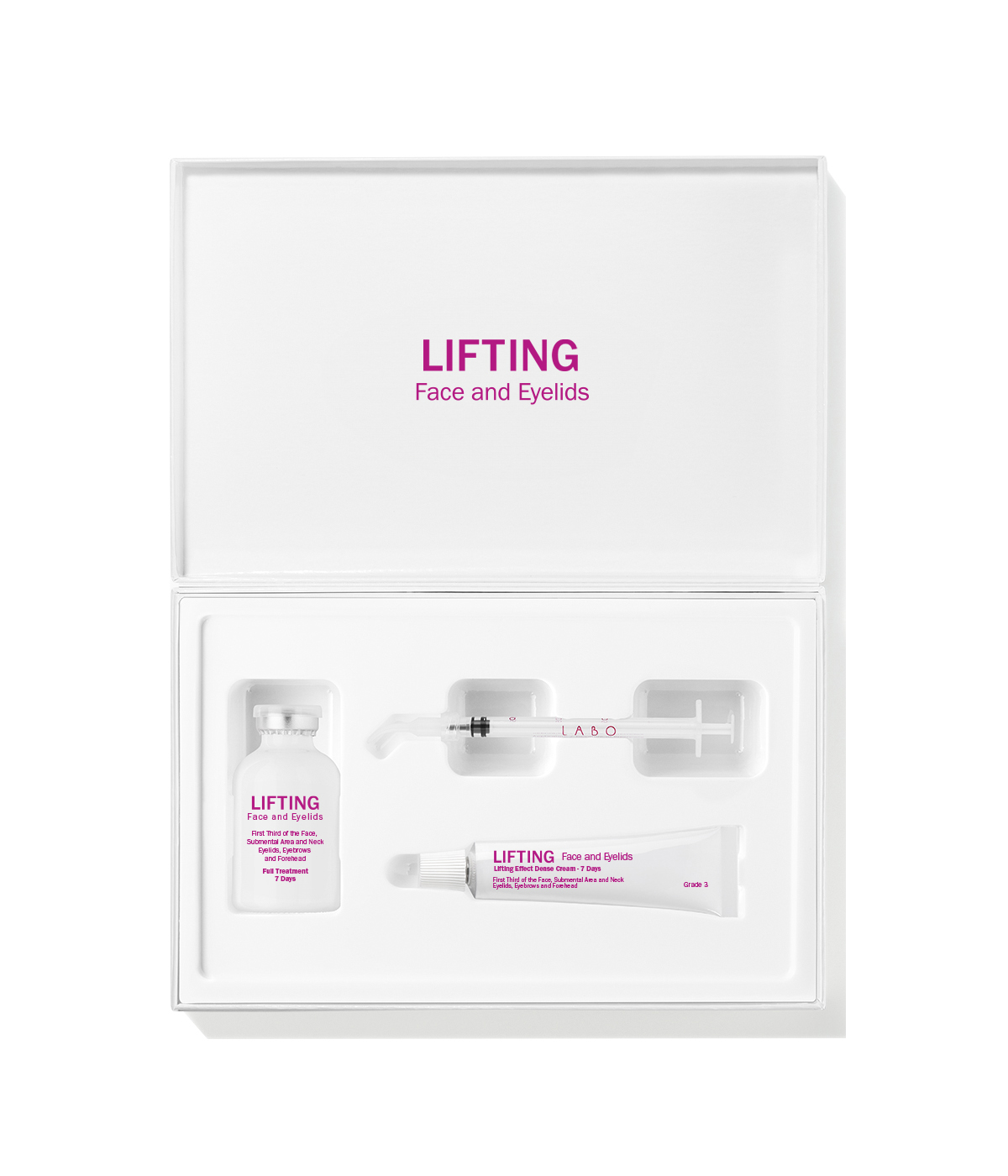
Lifting Face and Eyelids
Doggobone – Turkey Neck- Phthalates Free
- Vanillin Content: 0%
- Flashpoint: 82°C
- Discoloration: Light*
- CLP declaration: >7.7%
$ 23.22
🌍 Manufactured in Europe
🔬 CLP label guidance available
📥 Full technical documentation
🚚 Dispatch in 1-2 business days
Description It is a dermocosmetic preparation with a lifting effect on skin laxity that helps reduce the appearance of signs of sagging in the facial features of the lower face and neck, making the contours look firmer and more lifted. The Facial Lifting contains Lifteina Complex (Swiss Patent CH 712 905), composed of 9 ingredients whose absorption is supported by Labo Skin Technology: 2 of them exert a mechanical effect, and the other 7 provide a biological dermocosmetic effect. These components act synergistically and specifically on the skin of the lower third (inferior) of the face, the submental area, and the neck. EFFICACY IN VITRO STUDY An in vitro efficacy test was carried out on the components of Lifteina. The contraction technique on the collagen network allows simulating the interactions that normally occur in vivo between skin cells (fibroblasts) and collagen fibers. A collagen network and fibroblasts were exposed to the Lifteina component mixture. At pre-established intervals (1, 3, 4, and 7 days), the area of the network was photographed and measured. The mechanical and biological ingredients caused a progressive “contraction” of the network area, with a surface reduction of 45% compared to T0. These results are important for determining the “shrinking” ability of the Lifteina Complex on collagen fibers, which translates into a lifting effect on skin laxity in in vivo conditions. IN VIVO STUDY The double-blind, randomized, placebo-controlled clinical-instrumental study involved 40 female subjects (20 for each treatment type), each presenting signs characterized by mild/moderate skin laxity and sagging facial features linked to chronological aging. The study shows that, 12 hours after the first application and after 8, 16, 30, and 60 days of use, the Facial Lifting treatment – Lower Third of the Face, Submental Area, and Neck – can significantly reduce skin laxity, while redefining the facial features, cheeks, and neck. Facial Contours Regarding facial features, the treatment with the active preparation results in a lifting and remodeling effect in all areas of the lower oval of the face. This action translates into average variations in skin sagging of -0.71 mm, -0.93 mm, -1.25 mm, -1.80 mm, and -2.05 mm after 12 hours, 8, 16, 30, and 60 days, respectively. Additionally, at the end of the treatment, the maximum recorded result for the active group in terms of skin laxity reduction in the facial oval was -3.34 mm. The variations of this parameter, determined by the active preparation, are statistically higher than the results obtained for the placebo-treated group. Lower Third of the Face (Cheeks) Regarding the lower third of the face, i.e., the cheeks, the treatment with the active preparation results in a lifting effect with reduced skin laxity in the two considered areas of the cheeks. This action translates into average variations of the analyzed parameter of -1.08 mm, -1.21 mm, -1.29 mm, -1.75 mm, and -2.01 mm after 12 hours, 8, 16, 30, and 60 days, respectively. Additionally, at the end of the treatment, the maximum result recorded for the active group in terms of skin laxity reduction in the lower third of the face was -3.30 mm. The variations of this parameter, determined by the active preparation, are statistically higher than the results obtained for the placebo-treated group. Neck The treatment with the active preparation results in a lifting effect on the two areas of the neck, with reduced skin laxity. This action translates into average variations of the analyzed parameter of -1.14 mm, -1.11 mm, -1.68 mm, -1.88 mm, and -2.14 mm after 12 hours, 8, 16, 30, and 60 days, respectively. Additionally, at the end of the treatment, the maximum result recorded for the active group in terms of skin laxity reduction in the neck was -4.10 mm. The variations of this parameter, determined by the active preparation, are statistically higher than the results obtained for the placebo-treated group. In conclusion, from the results obtained in this clinical study, it can be concluded that in the three treated areas (7 points), the average reduction of SKIN LAXITY for the active group is -0.98 mm, -1.08 mm, -1.41 mm, -1.81 mm, and -2.07 mm after 12 hours, 8, 16, 30, and 60 days, respectively. Additionally, at the end of the treatment with the Facial Lifting Gel (16 days), 100% of the subjects in the study showed an overall improvement in the skin sagging of the facial contours, cheeks, and neck, a percentage that remained constant until the end of the study (60 days) with the additional use of the Facial Lifting Dense Cream. Considering the lower third of the face (cheeks), the average reduction in skin laxity (parameter R0) for the active group is -2.3%, -4.4%, -7.0%, -10.3%, and 13.8% after 12 hours, 8, 16, 30, and 60 days, respectively. Consequently, the Facial Lifting treatment – Lower Third of the Face, Submental Area, and Neck leads to increased skin firmness. At the end of the treatment with the Facial Lifting Gel (16 days), 95% of the subjects in the study showed improvement in skin laxity. The percentage of subjects improving remained constant (95%) until the end of the study (60 days) with the additional use of the Facial Lifting Dense Cream. Also, for the R0 parameter, the variations determined by the active product are statistically higher than those recorded for the placebo-treated group.
Bestsellers
Best Seller
Best Seller
Best Seller
Best Seller
Best Seller